PUCO announces new rules requiring utilities to publish ‘distribution hosting capacity maps’
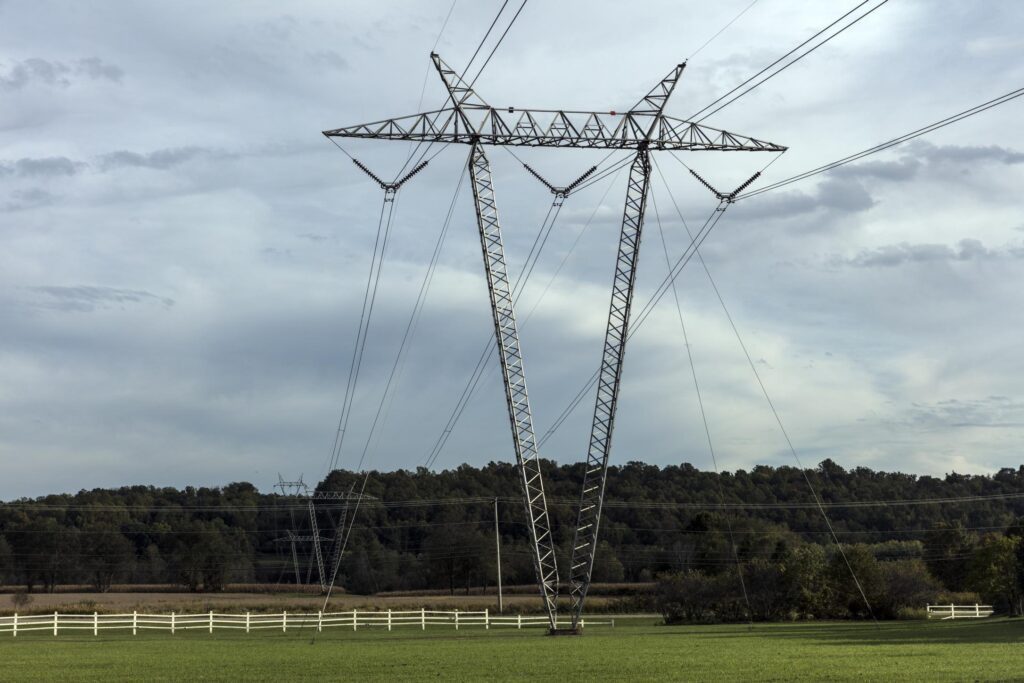
A line of enormous power towers and electric cables in Muskingum County, Ohio. (Photographs in the Carol M. Highsmith Archive, Library of Congress, Prints and Photographs Division.)
The Public Utilities Commission of Ohio has begun implementing key provisions of House Bill 15, a sweeping energy reform law enacted last year, by directing the state’s electric distribution utilities to develop and publish distribution hosting capacity maps by May 31.
The new directive, announced on March 4, requires utilities to create interactive online maps showing the grid’s available capacity — in megawatts — for interconnecting new Distributed Energy Resources or DERs such as rooftop solar, battery storage and small-scale generation, as well as additional loads.
Maps must include circuit-level or finer details where possible, covering total hosting capacity for new loads, separate figures for DERs, potential constraints, voltage levels, feeder capabilities and substation data.
Utilities will also be required to update the maps at least quarterly to reflect evolving grid conditions. The PUCO has also directed utilities to submit compliance plans with development timelines, following stakeholder input.
As previously reported, HB 15 — signed by Gov. Mike DeWine in May of 2025 — repealed remnants of the controversial 2019 House Bill 6, ending subsidies, certain utility automatic rate mechanisms, and promoting competition in the retail energy market. The bill also reduces tangible personal property taxes on new generation and infrastructure starting in 2027, and supports economic growth by addressing surging electricity demand from data centers, manufacturing and other sectors.
The law aims to ensure reliable, affordable power while attracting investment and enhancing grid transparency. The hosting capacity maps will supply lawmakers and regulators with granular-level data — beyond what is currently available through federal EIA dashboards — informing future decisions by providing public visibility into where DERs can connect efficiently without extensive upgrades.
Proponents, including clean energy developers, say the tools will streamline project siting, reduce interconnection delays and encourage private investment in renewables and storage — complementing HB 15’s broader push for market-driven generation expansion and reliability.
The PUCO also applauded the effort, describing the maps as promoting transparency for engineers, developers, stakeholders and the public to support grid planning and DER integration.
The commission’s action aligns with other HB 15 implementation efforts, such as finalized retail supplier enrollment rules that will reportedly enhance consumer protections and separate data center tariff approvals to shield ratepayers from infrastructure costs — an issue currently at the center of an ongoing battle between Buckeye lawmakers and DeWine.
Going forward, the maps are expected to accelerate distributed resource deployment, inform targeted grid investments and help Ohio balance growing demand with affordability and reliability.
Related Stories
Don’t know whether the Democrat is anti-war? Just ‘spitball and improvise,’ Dem organizer says in undercover video

Rep. Michelle Teska urges legislative action to require English proficiency rules amid public safety concerns