Republicans propose state-level efficiency commission

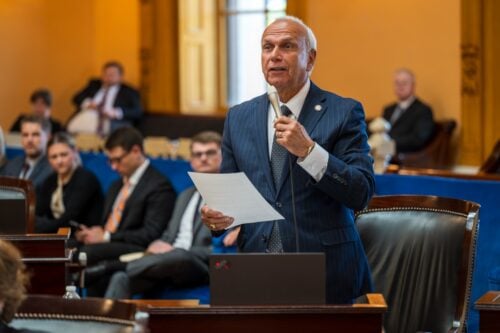
Ohio Rep. Mark Hiner, R-Howard, gives a floor speech honoring the Mount Vernon wrestling team. (Photo courtesy of Rep. Mark Hiner's office)
Two Ohio House Republicans want to improve the state government’s efficiency and are proposing the creation of a State Government Efficiency Commission.
Under Ohio House Bill 454, proposed by Rep. Mark Hiner, R-Howard, and Rep. Ty Mathews, R-Findlay, state department directors would be required to collaborate with the new commission to review state agency functions and recommend cost savings by eliminating duplication and overlap.
The commission would be composed of seven members, three appointed by the Speaker of the House, three by the President of the Senate and one member appointed by the Office of Budget and Management. Legislative members would serve concurrent terms, and each appointing authority may remove its appointee.
Key responsibilities for the commission include identifying and reviewing overlapping functions among state departments, recommending improvements, estimating potential cost savings, and preparing an annual report summarizing its findings and recommendations. Members would receive no compensation for their work but would be reimbursed for necessary expenses.
Initially, it appears to be a companion commission that follows the lead of the federal Department of Government Efficiency, better known as DOGE. After all, Mathews is a co-vice chairman of Ohio’s DOGE Caucus, which was formed earlier this year.
When speaking to Gongwer News Service, Mathews said the legislation was not directly born out of the Trump Administration’s focus on DOGE, although he does say there are many similarities between the two efforts.
“We want to see and really focus on any type of duplication,” Mathews told Gongwer News Service, “any inefficiencies that we could potentially consolidate at the state level, with the primary goal of making government easy for the end user, for the citizen, to be able to navigate, rather than getting pushed to one department to the next department.”
One significant difference between the State Government Efficiency Commission and DOGE would be that, unlike DOGE, the commission could not fire state employees. However, it is entirely possible that the work of the commission could lead to state employees looking for new work elsewhere if programs become consolidated as a result of commission recommendations.
Insiders say they expect some on the right side of the aisle to question whether this new effort adds another level of bureaucracy rather than taking meaningful steps to reduce it. They also expect to address questions about what level of authority the body will wield, and whether its recommendations will have any binding power at all.
“I think a lot of times we’re doing the same thing twice and that’s not a good use of taxpayer dollars,” Hiner told Gongwer News Service. “I’d like to try to identify those things and streamline them, or eliminate them, or whatever we need to do to make them efficient.”