Senate passes landmark voter ID amendment to be added to the ballot
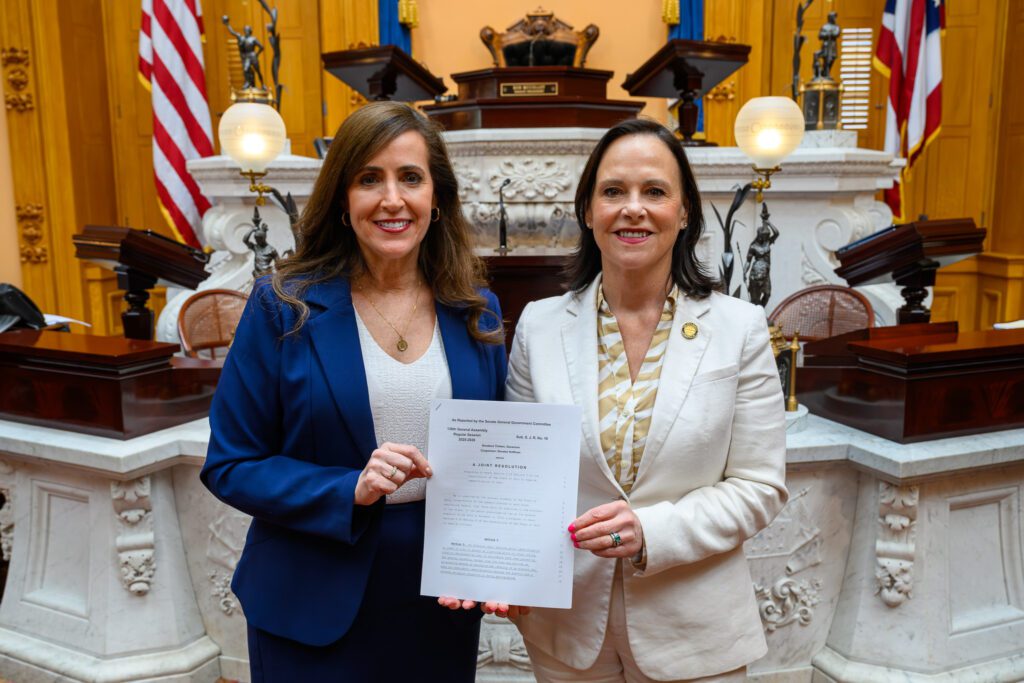
The Ohio Senate has passed Senate Joint Resolution 10, a measure that would place a constitutional amendment requiring photo identification to vote before Ohio voters in November.
Sponsored by Sens. Jane Timken, R-Jackson Township, and Theresa Gavarone, R-Bowling Green, the resolution aims to embed the state’s existing voter ID law in the Ohio Constitution, making it more difficult for future legislatures or courts to alter it.
Under current Ohio law, enacted in 2023, voters must present a valid government-issued photo ID when casting ballots in person on Election Day or during early in-person voting.
Today, @Restoring_USA president @Justin_Riemer testified in support of Ohio’s SJR 10, a bill that would strengthen voter ID laws in the state.
“SJR 10 is a lasting solution. It enshrines voter ID at the [state] constitutional level, while leaving the general assembly to set the… pic.twitter.com/YNroQoanFI
— Jason Snead (@jasonwsnead) June 3, 2026
However, as explained by Justin Riemer, president of Restoring Integrity and Trust in Elections, even successful, court-upheld, and popular voter ID requirements can be undone when political control of a legislature shifts.
Testifying in favor of the amendment on Wednesday, Riemer told lawmakers that Virginia became the only state to legislatively repeal a strict photo ID requirement in 2020, after Democrats gained control of the General Assembly.
Noting that election rules are “uniquely susceptible to partisan reversal when they rest on statute alone,” Riemer argued for the constitutional amendment, emphasizing that every election cycle can produce a new majority motivated to change statutes otherwise.
While the proposed amendment would constitutionally require electors to “provide identification in order to vote, in accordance with laws passed by the General Assembly,” it does not alter current statutes.
If a voter lacks an acceptable photo ID at the polls, they may still cast a provisional ballot and present valid identification later at the board of elections by the applicable deadline for it to be counted. Accepted forms will include an Ohio driver’s license or state ID, U.S. passport, military ID, Ohio National Guard card, or U.S. Department of Veterans Affairs ID.
However, the amendment has drawn scrutiny from opponents like the ACLU and the League of Women Voters.
If your gender identity or presentation does not match your voter ID, you cannot be turned away. As long as your legal name on your voter identification matches what is listed in the poll book, you can vote. 🏳️⚧️
Great thread from our friends at @transohio ⬇️ https://t.co/rw1qrtwzRV
— ACLU of Ohio (@acluohio) November 5, 2024
The ACLU, which raises money on fighting voter ID requirements, said the resolution is “intended to make voting more difficult, to have less otherwise qualified voters casting ballots.”
If approved by voters, the amendment would not overhaul election procedures; however, it would largely codify existing practice. In addition, if Ohio voters pass the constitutional amendment, it would then move through various rulemaking bodies.
The Secretary of State’s office, in coordination with the 88 county boards of elections, would be required to conduct several rounds of rulemaking with public comment periods, ensuring measures are in place for eligible voters without ID.
We’re proud to assist Ohio's boards of elections with practical, proactive training that helps election officials spot threats before they become incidents. Just the latest step Ohio is taking to protect our elections and critical infrastructure.
Learn more about the new program… pic.twitter.com/2XQyEtGCHL
— Frank LaRose (@FrankLaRose) June 2, 2026
The 88 Ohio Boards of Election add another layer of public oversight, ensuring that any proposed rules are consistent with local election policies.
While the General Assembly could pass conforming legislation to refine acceptable ID types as technology evolves — for instance, addressing concerns over AI-generated forgeries — any legislative updates would trigger corresponding administrative actions prior to implementing changes.
"The integrity of our elections is central to the public trust in government and faith in the future of our Republic."
Heritage Action’s Paul Lagemann testified in support of Ohio’s SJR 10 to protect voter ID in the state constitution. pic.twitter.com/gCLtjV5s4i
— Heritage Action (@Heritage_Action) June 2, 2026
For now, the resolution moves to the Ohio House, where it needs a three-fifths majority for passage before heading to the ballot. Ohio News will continue tracking developments on this and other election-related measures.
Related Stories

PAC ad slams Amy Acton for dodging debate with Vivek Ramaswamy

Ohio removes 75 noncitizen voter registrations in latest citizenship review