State halts payments to eight more ‘high-risk’ Medicaid providers
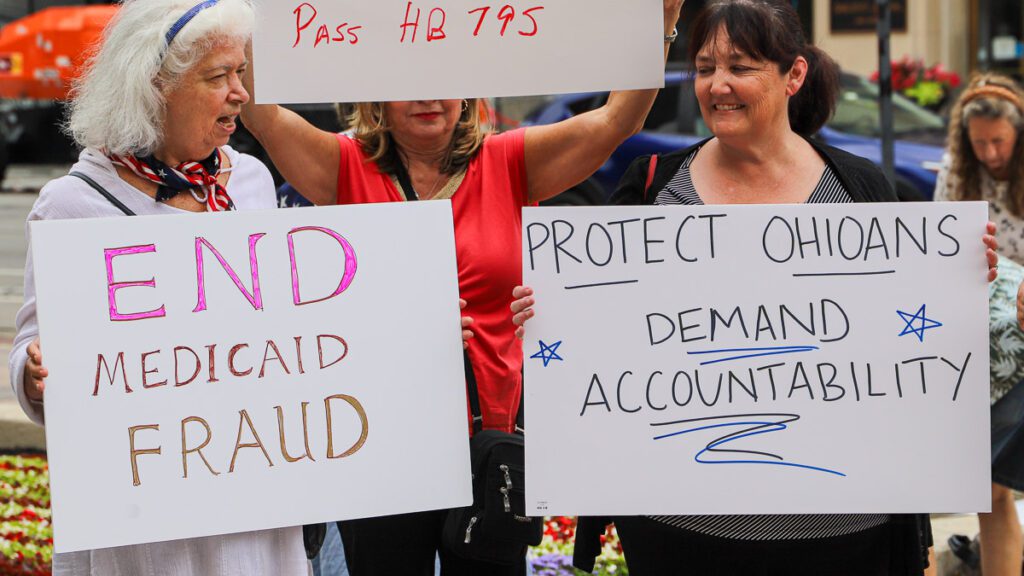
Ohioans participate in an Americans For Prosperity-Ohio rally at the Ohio Statehouse against Medicaid fraud. (Photo by Todd DeFeo)
Ohio’s Department of Medicaid has suspended payments to eight more high-risk providers as it continues its probe into potentially fraudulent Medicaid providers in an effort to stop paying fraudulent claims.
The latest announcement on Tuesday comes as lawmakers advanced Medicaid integrity reforms last week.
The news follows lawmakers’ passage of substitute Senate Bill 315, the Ohio Medicaid Program Integrity and Fraud Prevention Act. The comprehensive legislative package is with Republican Gov. Mike DeWine for consideration.
The reforms aim to strengthen oversight and accountability within the system, ensure transparency, target high-risk providers to ensure quality care, boost fraud reporting requirements, implement guardrails around home-health services, and enhance penalties for Medicaid fraud.
“Medicaid has long been ripe for abuse by bad actors who seek to rob taxpayers for their own gain,” state Rep. Josh Williams, R-Sylvania Twp., who helped introduce and advocate for the comprehensive anti-fraud legislation, said in a release.
“With the passage of Sub SB315, our state is finally standing up and saying no more,” Williams added. “…We are placing fraudsters and criminals on notice that they will spend decades behind bars if they continue to rob our taxpayers through Medicaid fraud—they will be found, arrested, and convicted.”
DeWine recently signed an anti-fraud executive order focused on Medicaid, but the legislation takes it a step further. The executive order was signed on June 2 and expires 120 days later.
Nearly 60 high-risk providers have had their payments suspended due to unusual billing patterns and data anomalies that indicate a high probability of fraud, ODM officials said.
The additional group of eight is all connected to at least one of the 49 high‑risk Medicaid home health providers suspended earlier this month. Under DeWine’s executive order, ODM can stop payments to providers related to those already suspended.
“This next round of suspensions shows that we are actively following the data where it leads,” ODM Director Scott Partika said. “When patterns point to connected entities or coordinated behavior, we act quickly. Our commitment is to safeguard Medicaid dollars and protect the Ohioans who rely on these services.”
DeWine’s executive order gives ODM the authority to stop payments before they are made in an effort to keep public money in the coffers and deter fraudsters from submitting fraudulent claims. These eight additional providers are under review and will have payments suspended while investigations continue.
Other efforts to cut off fraudsters include a six-month moratorium on new provider enrollments in high-risk categories, more frequent revalidation of providers identified as higher-risk, and accelerated implementation of GPS-based Electronic Visit Verification for in-home services.
The ODM’s proactive efforts to fight fraud follow a major crackdown by federal authorities, also announced in early June, that involved state and federal indictments for $42 million in Medicaid fraud.