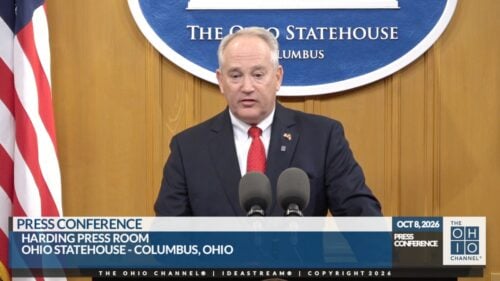
State Rep. Tom Young bill eliminates capital gains tax

An Ohio legislator recently advocated abolishing the state’s capital gains tax, which is imposed at both the state and local levels.
State Rep. Tom Young, R-Centerville, filed House Bill 617 to shield capital gains entirely from state and city income levies. Young said this would result in the state forgoing about $270 million in revenue, according to the press release shared with Ohio.News.
Capital gains taxes are charged on revenue earned from selling an asset for more than the purchase price.
“It’s not a big number compared to the budget,” he said. “But the positive thing about it is it enhances capital investment in Ohio by business and individuals, which is the direction we want Ohio to go.”
Young also said that his plan would encourage job growth.
“We’ve cut income tax and the CAT, which helped increase capital investment in the state, bringing people in who want to start a business. Why shouldn’t we do that with capital gains as well?” he said.
As of December 2025, Alaska, Florida, Nevada, New Hampshire, South Dakota, Tennessee, Texas and Wyoming are the only states that don’t have income taxes, according to the report by the Tax Foundation.
“It’s not a huge amount of money,” he said, “but it shows the favorable intent of the commitment of the Legislature in the state of Ohio that we are business attractive.”
If Ohio follows through, it would become only the second state to eliminate capital gains taxes. The first state to do so was Missouri, when Republican Gov. Mike Kehoe signed House Bill 594 into law earlier this year. The recent law is expected to cost the state $430 million in its first year.
Ohio Republicans praised Young’s solution to cut “unfair taxes” while Democrats criticized the idea, saying that it would only benefit the “ultra-wealthy.”
Before Young made the announcement, Texas lawmakers enshrined a permanent ban on any capital gains tax (including unrealized gains) via Proposition 2 in November 2025. Meanwhile, voters in Washington state preserved their 7% capital gains excise tax by rejecting Initiative 2109.
In addition to Young’s proposition, lawmakers have also been introducing and passing property-tax-related reforms.
The Senate recently passed House Bill 124 for fairer valuations. Other House bills (129, 186, 309, 335, and others) aim to deliver more than $2 billion in relief over three years through inflation caps, senior discounts and levy transparency.
Additional measures would raise the voter threshold for new levies to 60% and explore shifting some of the property tax burden to sales taxes.