U.S. House Oversight task force holds first hearing on Ohio Medicaid Waiver fraud
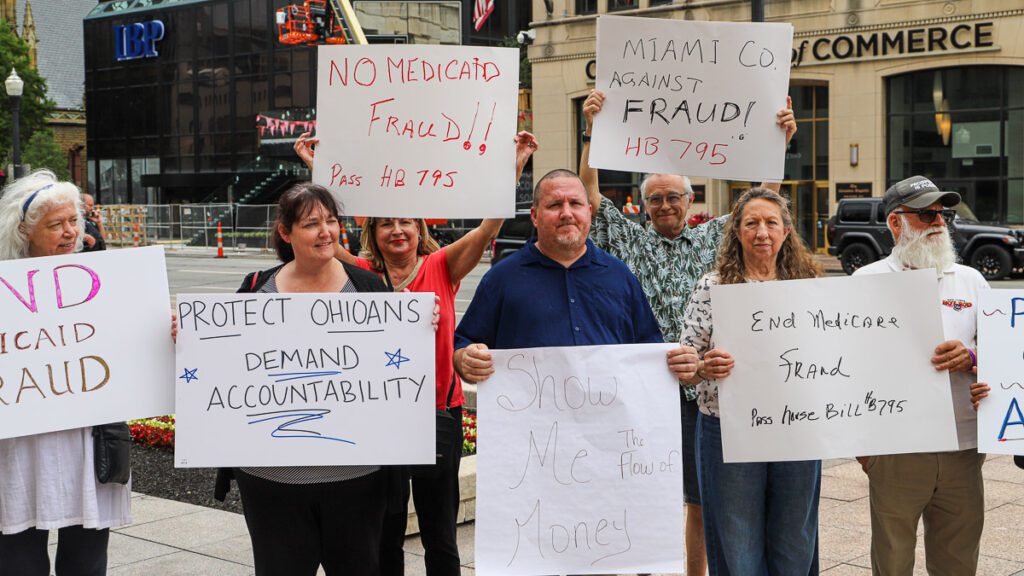
Ohioans participate in an Americans For Prosperity-Ohio rally at the Ohio Statehouse against Medicaid fraud. (Photo by Todd DeFeo)
The U.S. House Oversight Task Force on Defending Constitutional Rights and Exposing Institutional Abuses held its first hearing on Ohio Medicaid Waiver Fraud last week as federal officials announced plans to prosecute perpetrators.
Federal officials visited Ohio to announce federal charges against nine Medicaid fraudsters, including two Ohio state employees and two co-conspirators accused in a $30 million Medicaid billing scheme.
The Ohio Department of Medicaid also recently announced that payments to providers that have exhibited signs of fraud have been suspended, and that the department will take steps to identify and prevent fraudulent activity.
The task force focused on fraud in Ohio’s Medicaid Home and Community-Based Services waiver program during the June 3 hearing. The program was adopted in 2014 and pays people to visit beneficiaries to perform personal care services.
“This is something we’ve seen before,” Brandon Gill, R-Texas, said at the beginning of the hearing. “Just a couple months ago, the House Oversight Committee examined a similar problem in Minnesota, where Somali fraudsters stole over $16 billion from American taxpayers. Today we will be examining Ohio, which appears eerily similar.”
Luke Rosiak, an investigative reporter at The Daily Wire who testified at the hearing, said that the fraud in Minnesota is connected to fraud cases in Ohio.
Federal agents told Just the News that $136 million in cash has been found in outbound luggage from the John Glenn Columbus International Airport since November 2023, and that the cash was then moved from Minneapolis, Minnesota, to overseas locations by members of multiple Somali immigrant communities.
“The federal government built a program so easy to gain that a convicted fraudster can get approved to send unsupervised and untrained workers into elderly Americans’ homes, and a refugee family can collect $90,000 a year simply by having one family member claim to be the other’s caregiver with no verification and little oversight,” Rosiak said. “Medicaid calls this personal services, home healthcare, and my investigation found millionaire tax cheats, almost all of them foreign-born, ripping off taxpayers at a scale that threatens to bankrupt America.”
The state Department of Medicaid announced that payments to 49 high-risk Medicaid home health providers had been suspended for exhibiting red flags of potential fraud, and that the providers are currently under review.
The department also announced that it would be implementing new policies under an executive order from Gov. Mike DeWine, including enacting a six-month moratorium on new enrollments for high-risk provider categories, requiring more frequent revalidation of providers identified as high-risk, and accelerating the implementation of GPS-based Electronic Visit Verification (EVV) to better monitor in-home services.
“Since taking office, my administration has worked aggressively to identify fraud, waste and abuse and control failures,” Ohio Auditor of State Keith Faber said. “To date, we’ve identified more than $9 billion in unsupported or fraudulent public expenditures, with Medicaid and unemployment programs representing the two largest areas of concern…And this year’s single state audit, which is a rigorous, comprehensive financial compliance audit, we identified potentially up to $4.4 billion in fraud-related exposure connected to ineligible recipients in Ohio’s Medicaid program. Our testing found an ineligible rate of 15.6%.”
“There’s thousands of people involved. I would say the majority of Bhutanese people are either on Medicaid, home healthcare, or are providing Medicaid home healthcare services. They had recently 15,000 people.”
The Daily Wire reported that 288 “home health” companies had fraudulently taken $250 Million from the waiver program in May.
The companies were based in seven office buildings in Columbus. The majority of the offices were empty when Rosiak visited the sites.
One occupant told him that the companies channel Medicaid funds to family members of elderly people who are not set up to be paid for home services through the waiver program.
“Medicaid fraud harms taxpayers, certainly,” state Rep. Mike Dovilla, R-Berea, said in a committee testimony. “But it also harms legitimate providers who follow the rules. It harms caseworkers and public servants whose work is undermined by weak systems.”
“Most importantly, it harms the truly vulnerable Ohioans who depend on Medicaid and whose care is threatened when finite resources are diverted to those who do not qualify or to providers who exploit loopholes.”
Ohio Attorney General David Yost filed indictments against eight Medicaid providers for allegedly stealing $181,512 in Medicaid funds in April.
Related Stories
Rep. Dovilla responds to Auditor’s Medicaid verification gap findings: ‘Ohio shouldn’t be writing the check’

21-year-old Columbus man pleads guilty to social posts threatening to kill federal immigration agents