Ohio Department of Children and Youth stops funding for 10 daycares, citing $1 million in overpayments
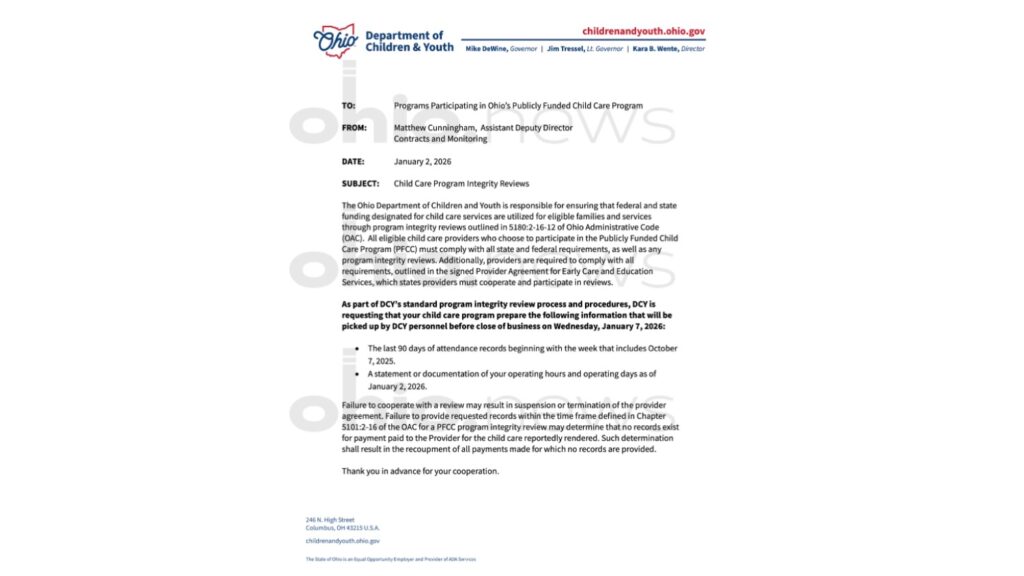
Ohio officials have stopped funding to 10 daycare centers after discovering of $1 million in overpayments.
Following reports of fraud in Minnesota and elsewhere, the Ohio Department of Children and Youth launched “program integrity reviews” in January at the state’s publicly funded child care programs, citing concerns about potential fraud.
As part of the effort, the department said it conducted a random-sample review of 400 licensed child care providers that receive taxpayer-funded child care. There are about 5,200 childcare centers in Ohio, and state officials argue that the total is a statistically valid sample of providers with agreements to provide publicly funded child care in the state.
DCY identified the 10 programs as:
- Advanced Learning Center, Franklin County
- Buzy Bee Child Care, 2 LLC, Franklin County
- Fresh Start Academy, Franklin County
- From Start to Finish Academy, Cuyahoga County
- Hart with Heart Family Childcare, Cuyahoga County
- Mercy Hands Daycare, LLC, Franklin County
- Nature w/Nurture Preschool and Day School, LLC, Hamilton County
- Rose Child Care Center, Franklin County
- Sunnyside Daycare, Franklin County
- The Learning Tots Academy, LLC, Franklin County
Projecting based on the random sample, state officials said the overpayments represent roughly 1.6% of the $969 million in annual expenditures for taxpayer-funded child care.
The agency said that another 12 programs had more than $130,000 in overpayments, stemming from administrative errors or inconsistencies. Officials said they were addressed through technical assistance and additional follow-up.
“When DCY was created in 2023, a core principle was to move Ohio’s child care system toward stronger accountability, smarter oversight, and responsible stewardship of public funds, while preserving access for eligible children and families,” DCY Director Kara Wente said in a statement. “Any dollar not used to support children and families is unacceptable.
“We will continue to find ways to prevent fraud from happening, and when fraud is reported or suspected, we will continue to investigate quickly, act on our findings, and recover the funds,” Wente added. “Program integrity is a core operational priority. We use data, policy, and enforcement to protect children and taxpayers, and we are committed to continuing to evolve and improve.”
Since the start of the year, DCY officials said the agency has received more than double the number of unduplicated tips from the public, DCY licensing staff and county partners than last year.
While state officials have trumpeted recent successes in cracking down on fraud, their approach has been somewhat hamfisted. Republican Gov. Mike DeWine has insisted the state has robust anti-fraud measures in place, but his assurances have done little to assuage critics who say the state needs a more robust posture.
Amid increasing criticism, the governor signed an executive order allowing the Ohio Department of Medicaid to enforce emergency rules, including more frequent revalidation of providers identified as higher risk of fraud.
Additional allegations have centered on Medicaid fraud, and some estimates have intimated that the total could top $1 billion. Ohio Auditor of State Keith Faber told lawmakers that his office has released major Medicaid public interest audits identifying program weaknesses and roughly $1.9 billion in questioned, improper, or high-risk payments.
“As you are aware, this space continues to ebb and flow with new allegations against providers daily,” Ben Karrasch, the section chief of the Health Care Fraud Section and director of the Medicaid Fraud Control Unit within the Ohio Attorney General’s Office, said in prepared testimony to the Joint Medicaid Committee this week.
The committee is considering House Bill 795, which would ostensibly strengthen anti-fraud measures.
Faber told the committee that since the office launched its public benefits fraud page at the start of the year, it has received more than 200 calls from Ohioans reporting concerns about potential fraud.
“That is exactly why reporting systems matter. Most of our fraud cases begin with tips,” Faber said in prepared testimony. “When more people know what to look for and where to report it, more problems come to light.”
Added Faber, “And our most recent State Single Audit again identified serious concerns. Medicaid is routinely included in the State Single Audit, and this year’s audit identified potential fraud-related concerns in Ohio Medicaid programs estimated between $800 million and $4.4 billion.”
Related Stories
Ramaswamy campaign agrees to debate — Acton campaign declines, opting to hurl insults instead
Cincinnati man pleads guilty to vandalizing Vice President JD Vance’s home