Ohio Lawmakers pass first-in-the-nation tort reform measure
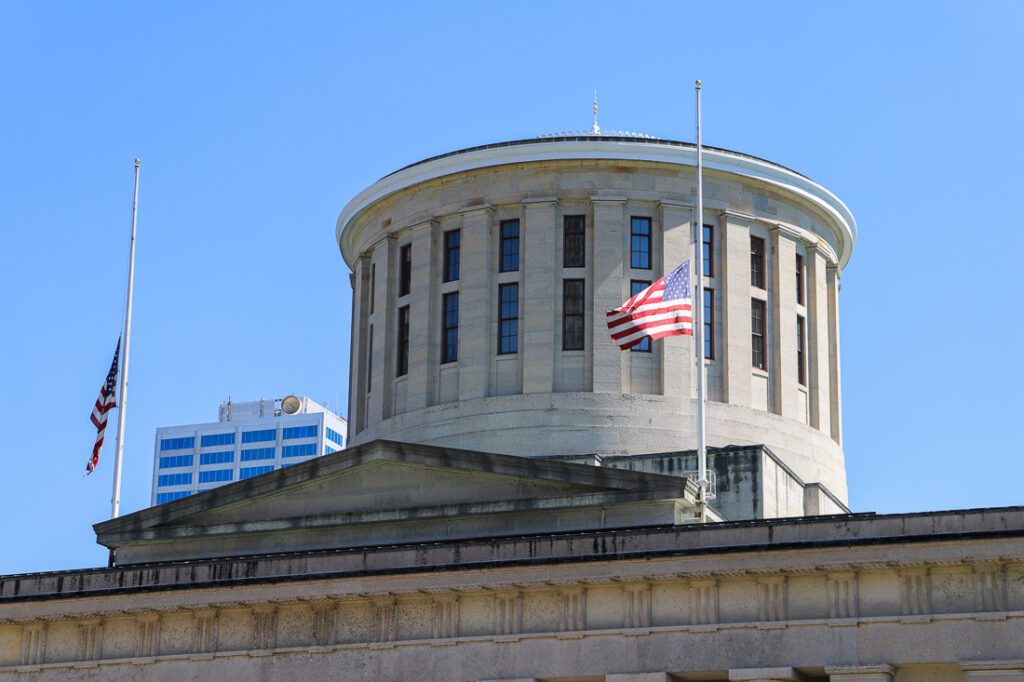
An April 2026 view of the Ohio Statehouse. (Photo by T.A. DeFeo)
The Ohio Senate passed House Bill 105 last week, sending to Republican Gov. Mike DeWine what sponsors call the nation’s first comprehensive tort reform effort, a measure targeting “non-recourse third-party litigation funding” by foreign governments, corporations, and investors, an “opaque” billion-dollar industry few are even aware of.
Sponsored by state Reps. Meredith Craig, R-Smithville, and Jim Thomas, R-Jackson Township, the legislation aims to prevent hidden actors or anonymous funders from influencing legal outcomes behind the scenes, while banning any foreign government, foreign corporation, or foreign investor involved in third-party litigation funding.
In what some have called an “opaque billion-dollar industry,” the practice of speculative third-party investing into litigation by large hedge funds and foreign entities has increased significantly over the years.
Burford Capital has convinced a U.S. appeals court to throw out a $50 million antitrust settlement involving its former client Sysco , in a case one judge called a "cautionary tale" about the influence of third‑party litigation financing. https://t.co/381z0rmcTY
— Reuters Legal (@ReutersLegal) February 6, 2026
Following multiple high-profile class-action cases, critics argue that the practice allows third-party investors to essentially hold settlement agreements hostage to secure higher returns.
Wholesale food distributor Sysco Corporation is taking on Burford Capital, who Sysco says is committing “litigation hostage,” by axing agreed-upon settlements. #FairLegalFundingNow https://t.co/0iiM4RcAQI
— CFLF (@CFLF10) April 19, 2023
In the Sysco Corp. antitrust litigation against beef and pork suppliers, Burford Capital provided roughly $140 million in funding. When Sysco sought what it viewed as reasonable settlements, Burford allegedly blocked them to maximize its return, effectively holding the company “hostage” in prolonged litigation.
A federal judge later criticized such arrangements for turning courts into “trading floors” and prioritizing investor profits over plaintiff interests.
A judge blasted lawsuit investor Burford for turning courts into "trading floors." But that still doesn't mean Burford can't undo a $50M deal that would have ended a court fight between its investee, Sysco, and Pilgrim's Pride https://t.co/24ruv66mCA
— Cook County Record (@CookRecord) February 7, 2026
Foreign involvement has also raised alarms. Chinese entities and Russian-linked investors have quietly funded U.S. lawsuits, altering policies through consent decrees, while also gaining access to trade secrets through discovery.
The disclosure of a litigation funder tied to China “is our worst fears confirmed,” said Joe Matal, former acting dir. of @USPTO & founder of firm Clear IP.
But Gary Barnett, exec. dir. of @ILFA_Official, called national l security concerns re: lit. finance “pure speculation.” pic.twitter.com/RMcMpbZuBl
— Christopher Yasiejko 🌻🇺🇦 (@yasiejko) November 6, 2023
Arguing that Ohio currently ranks as the 15th-worst state for lawsuit abuse, and that civil liability is costing the average household more than $2,500 annually, proponents urged lawmakers to pass the bill to stop the distortion of justice.
Opponents, such as Cameron Sholty, the Executive Director of Heartland Impact, argued that the bill goes too far.
“House Bill 105 goes beyond those concerns. As drafted, it risks chilling legitimate litigation support,” Sholty said.
“Even when names are redacted, the remaining information may allow defendants, political opponents, left-wing activists, or media organizations to infer who is involved and how similar cases are being funded.”
Adding that the bill risks a “chilling effect on public policy engagement,” Sholty emphasized the privacy concerns created by government-mandated exposure of private support for lawful advocacy.
Ohio's HB 105 is being sold as litigation finance reform, but in practice it would disarm the conservative orgs that challenge DEI, ESG, & government overreach while leaving deep-pocketed leftwing groups untouched. @kenblackwell hits the nail on the head!https://t.co/JWWF8bYo29
— Heartland Impact (@HL_Impact) June 8, 2026
“Individuals and organizations should not have to risk harassment, retaliation, or public pressure simply because they support litigation involving constitutional
rights, religious liberty, property rights, free speech, parental rights, election integrity, or limits on government power,” Sholty said in prepared testimony.
The bill, which draws on the National Conference of Insurance Legislators’ model legislation on third-party litigation funding — Transparency in Third Party Litigation Financing Model Act — would create a uniform registration and oversight system under the Attorney General.
According to the bill’s sponsors, it will bring greater transparency to third-party litigation funding and certainty for Ohio’s businesses.
“The business of nonrecourse litigation funding has operated without guidelines for too long,” Craig said. “House Bill 105 protects our judicial system from outside influence, guards against interference, and will ensure that justice in Ohio is never for sale to foreign actors.”
SOMETHING HIGHLY DISTURBING IS HAPPENING IN THE SHADOWS ⚠️
Foreign actors like George Soros can use a special loophole called "Third Party Litigation Funding" to ABUSE the U.S. legal system 🚨
They come in as “outside investors” in lawsuits, paying legal fees for plaintiffs,… pic.twitter.com/UQaJasF4xv
— Matt Wallace (@MattWallace888) June 28, 2025
“An important component of a strong business environment is a stable and predictable civil justice system,” Thomas added. “This bill will protect Ohioans, consumers, and businesses and help our state improve its standing.”