Ramaswamy touts primary win to show momentum
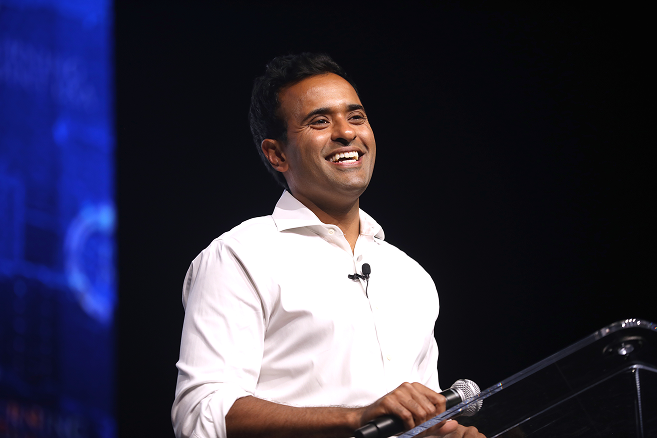
Vivek Ramaswamy’s campaign is pointing to his margin of victory in Tuesday’s Republican gubernatorial primary election as a sign of support for the Cincinnati native and biotech entrepreneur.
Ramaswamy picked up 82% of the vote, knocking off controversial candidate Casey Putsch, to firm up the nomination and set up a November showdown with the former director of the Ohio Department of Health, who left the post amid the COVID-19 pandemic.
The campaign noted that incumbent Republican Gov. Mike DeWine won the 2018 primary with 59.8% of the vote and the 2022 Republican gubernatorial primary with 48.1%. Republican U.S. Sen. Bernie Moreno won 50.5% during the 2024 Republican primary, while Vice President JD Vance won 32.2% during the 2022 Republican primary for the U.S. Senate seat.
“I am confident we’re going to win decisively, but I’m also confident that we’re going to have to work hard to get there,” Ramaswamy told Fox News Channel’s Sean Hannity. “So it was a great primary victory. I’m grateful … for probably the largest primary victory margin in modern Ohio history. The Republican Party is united.”
Ohio Republicans are more united than ever. Now onwards to victory in November. https://t.co/2TAHdC6FAX
— Vivek Ramaswamy (@VivekGRamaswamy) May 7, 2026
The race’s early theme appears to center on affordability, mirroring the broader national conversation.
“I am running for governor because people in this state are struggling,” Acton said, per the Ohio Capital Journal. “They are doing everything right. They’re working harder than they ever have, but there is no more breathing room. They’re struggling with the cost of everyday life, and I refuse to look the other way.
“When you are looking at a state from 30,000 feet, my opponent cannot possibly see the struggles and the stories that I’m hearing on the road,” Acton added to the publication. “Vivek Ramaswamy isn’t just out of touch. He is out for himself. That is what is happening here.”
For his part, Ramaswamy has labeled Acton a “socialist,” while the former health department head, who is blamed for shuttering the state during the pandemic, blasts Ramaswamy as a “billionaire.”
“Let’s start with getting the state to a zero-income tax state, get rid of the capital gains tax, bring down the property tax burden,” Ramaswamy told Hannity. “By downsizing the overgrowth of bureaucracy and government. It’s time-tested. It works. Put more money in the pockets of Ohioans. Lower costs, bigger paychecks, produce more energy — that brings down those electric bills.
“Cut the red tape that gets in the way of building more homes,” Ramaswamy added. “That’s how we bring down the cost of housing and make home ownership more affordable for the next generation. That’s not right versus left. It’s common sense, and that’s what I stand for.”
Lower costs. Bigger paychecks. Better schools. pic.twitter.com/S55ITC6PI0
— Vivek Ramaswamy (@VivekGRamaswamy) May 7, 2026
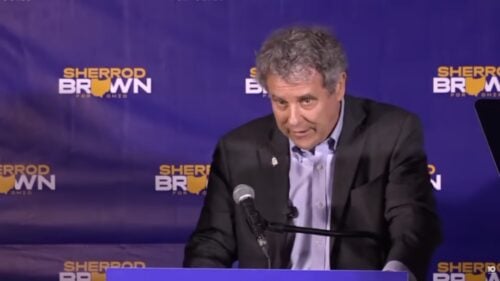
The governor’s race is probably one of the two highest-profile races on the ballot this November. The other is the U.S. Senate race, a showdown between Democrat Sherrod Brown, who served in the Senate until his 2024 loss, and incumbent Jon Husted, a Republican appointed to the post by DeWine after JD Vance was elected vice president.
“One of the most interesting dynamics of Ohio’s election season is the relative lack of political experience among some of the high-profile candidates,” Gilbert Michaud, an assistant professor of Environmental Policy at the School of Environmental Sustainability at Loyola University Chicago, told Ohio.News. “This increases the importance of early messaging, as voters will evaluate candidates on platforms and positioning rather than on track records.”
Michaud said this is particularly notable in the governor’s race, while the Senate race is a bit different.
“I think that the question here is about advantages with Husted as the incumbent vs. voter fatigue with a prior candidate in Brown,” Michaud added. “Taken together, both of these races will create an exciting and potentially unpredictable early voting environment. I see this early phase as more fluid and volatile than normal.”