Senate passes bill to require local governments to seek voter approval for traffic cameras

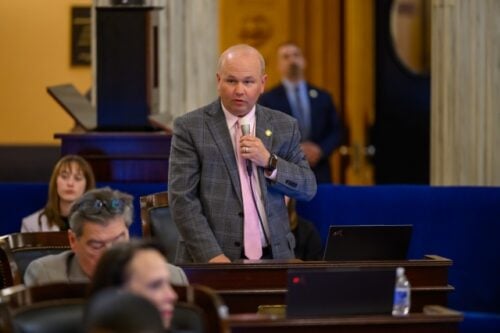
The state Senate passed legislation that would require local governments to seek voter approval for traffic cameras.
Senate Bill 340 would require municipalities to pass referendums before installing or renewing contracts for traffic cameras used to enforce red-light and speeding violations. Officials would have 90 days before a general or special election to certify the ballot measures.
The bill passed 31 to 1 on Nov. 18, after Sen. Tom Patton, R-Strongsville, introduced the legislation in January.
“Since 1991, voters have rejected 91% of all traffic camera approval referendums,” Patton said in a release. “This sends a clear message to local governments that the voters do not want the devices on their streets.”
Patton told Fox 8 that he believes bipartisan support for the bill will help it to pass in the House of Representatives.
Witnesses representing the Ohio Mayors Alliance, Ohio Municipal League, and the City of Dayton testified against the bill on the day it passed. Opponents said the legislation would prevent local governments from exercising the Home Rule clause in Ohio’s state constitution authority and could interrupt current red-light and speed-limit enforcement programs.
“As introduced, Senate Bill 340 would require municipalities to obtain voter approval to use traffic cameras,” Dayton Chief of Police Eric Henderson said. “The bill provides no express exception for existing programs and requires municipalities to certify their ballot resolutions at least 90 days before the election. For Dayton, that could interrupt photo enforcement in school zones where we already use cameras to address speeding.”
SB 340 will now be sent to the House for consideration. The bill has not been assigned to a committee yet.
Patton has previously sponsored legislation focused on traffic cameras, including four separate bills introduced in 2016. Several bills signed into law led to rulings by the state Supreme Court.
In a 2022 case, Newburgh Heights v. the State, the Ohio Supreme Court upheld a law that reduced state funds to municipalities that receive money from red-light and speeding fines issued by traffic cameras.
The court also ruled that a law that would have limited the use of traffic cameras, including requiring a police officer to be present at in-use cameras, would violate the Home Rule clause after the city of Dayton challenged the requirements in 2017.
Ohio legislators and local officials have also debated over the use of Flock Safety cameras, roadside surveillance devices that read and record passing license plates.
Four of Ohio’s leading law enforcement organizations recently released a statement asking state lawmakers to pass regulations to prevent the misuse of Flock cameras rather than ban them.
Columbus Mayor Andrew Ginther paused the use of the city’s 65 Flock cameras in September following allegations that a city police officer searched a single license plate more than 270 times without an apparent investigative purpose.