Bill that could ban DEI in public schools, prompting an expected political clash

A bill by an Ohio lawmaker that intends to ban diversity, equity, and inclusion initiatives in the state’s public schools resulted in an ideological collision between conservatives and leftists.
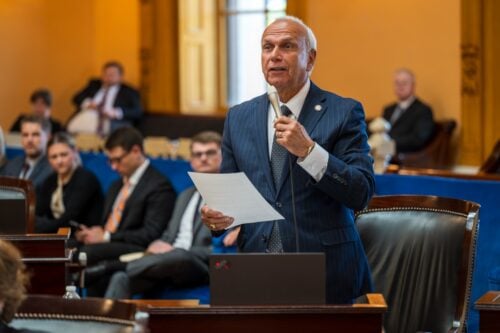
Senate Bill 113, which was sponsored by state Sen. Andrew Brenner, R-Delaware, would “require every public school board to ban DEI-related trainings, offices, job titles, and consulting contracts within 90 days of enactment” for grades K-12, according to Cleveland.com.
In his testimony to the state House Education Committee, Brenner, who is on the Senate Education Committee, said that the bill intends to go back to merit-based education, calling DEI a modern-day segregation against white people.
Liberals representing various organizations, including those directly related to education, strongly opposed the bill, with 80 people presenting their testimonies before the committee.
Gary Daniels of the American Civil Liberties Union, one of the bill’s opponents, said it never actually defines what DEI is while allegedly banning anything even remotely related to it.
“When school administrators, school staff, parents, stakeholders, and the state legislature all get to define for themselves what is ‘diversity, equity, and inclusion,’ then everything is diversity, equity, and inclusion and subject to banning,” he said.
Melissa Cropper of the Ohio Federation of Teachers also said in her testimony that, since there are no clear definitions, schools will try to act safely by overcomplying with the law, eliminating programs and people who are not directly connected to DEI.
Elizabeth Kirby of the Cleveland Heights-University Heights City School District agreed with Cropper in her testimony.
“Because the language is vague, people tend to fill in the blanks and err on the side of caution,” Kirby said. “When you have legislation that doesn’t have clear definitions or a real understanding, it tends to hurt kids, but also use and waste resources of the school district and the state as they try to interpret and figure things out.”
Even though there were people like Lisa Breedlove Chaffee of Parents’ Rights in Education, who took a moderate stance in her testimony in support of the bill, most of the bill’s proponents, including Darbi Boddy of Moms for America and Linda Harvey of Mission America, explicitly opposed the DEI initiatives in schools.
Boddy used Social Emotional Learning as an example of the school officials pushing DEI on students by allegedly taking “the personal and religious belief systems imparted by their parents and family members” and manipulating “them into thinking their parents are bad, ignorant, outdated, homophobic, and hateful bigots.”
“Social Emotional Learning then focuses on molding these students to fit into a future that communist and socialist authors of the curriculum envision for America — lifelong learners who question nothing and obey everything imposed on them by government, Big Pharma, and mainstream media,” she said.
SB 113 follows Senate Bill 1, which does the same thing at the higher education level. It was signed into law by Republican Gov. Mike DeWine last year.
State Sen. Jerry Cirino, R-Kirtland, the sponsor of SB 1, told Ohio.News in an exclusive interview that he is pleased with the state colleges and universities complying with the law, but admitted that it is still a work in progress because some educators, including at The Ohio State University, the University of Toledo, the University of Cincinnati, Bowling Green State University, and Kent State University, are still pushing back against the bill.
This raises the question of whether public schools in Ohio will comply with the bill if it becomes law, given that public school officials in Ohio are apparently still teaching DEI to their students, including in Dayton, Fremont City, Pemberville, and many other communities.
Brenner kept that in mind, which explains why his bill would block schools from relaunching DEI initiatives under different names to avoid complying with the law while still pushing the ideology.